
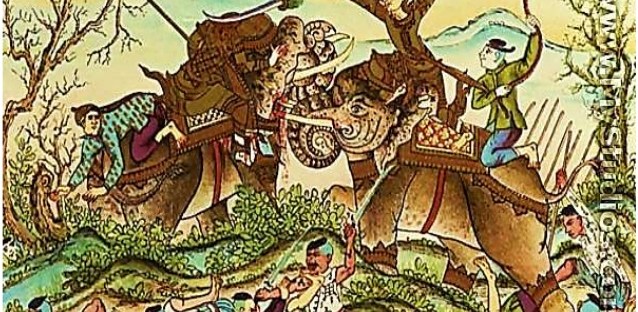
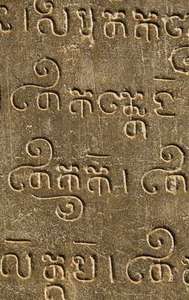
Cambodian Literature is mostly influenced by Thai and Indian Literature. Like most literature of Southeast Asian Nation, Cambodia’s literary forms are divided into two: oral literature and written literature. The following are the literary periods of Cambodian Literature
THE EARLY CAMBODIA LITERATURE
In the early times in Cambodia, epic poems and folktales were transmitted orally.
The earliest written works were dated back during the Angkorian era (9th-13th centuries) in Sanskrit verses written on palm leaf manuscripts. By the 11th century Buddhist texts and jataka were being produced on a regular basis.
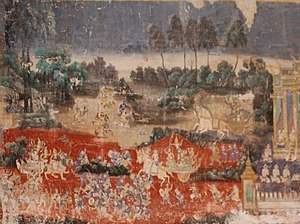
Mural depicting stories of the Reamker in Phnom Penh’s Silver Pagoda https://en.wikipedia.org/wiki/Reamker
The oldest work written in Khmer is the Reamker, the Cambodian version of the ancient Indian epic, Ramayana. It was inscripted on bas-reliefs and frescos at temples and pagodas throughout the country. Reamker has been taught in high schools until today.
From the 17th century onwards poems known as chbap (‘codes of conduct’) were written by Buddhist monks to teach values and morality. The same period also witnessed the appearance of satra lbaeng (‘works for pleasure’), lengthy verse-novels which recounted the ancient Jataka stories. Some of these works, written on palm-leaf manuscripts, were cleaned and microfilmed with aid funding for the National Library in the early 1990s.
Many popular folktales were not formally recorded, but are well-remembered and re-told, These include stories with a moral, animal tales such as those about Judge Rabbit, traditional riddles and sayings. From the 1950s to the 1970s some of these were collected and published by the Buddhist Institute, and more recently some NGOs have also produced illustrated versions of the old stories for children.
LITERATURE DURING FRENCH COLONIAL ERA
The era of French domination brought about a requestioning of the role of the literature in Cambodia. In the earlier times, monks oppose the mass production of Cambodian texts. French influence gave Cambodia a new perspective on the purpose and beauty of Literature. There was a generation of novelists in the early decades of the 20th century. These writers narrated the scenarios of ordinary Cambodian life.
The first book in the Khmer script in a modern printing press was printed in Phnom Penh in 1908. It was a classical text on wisdom, “The recommendations of Old Mas”, published under the auspices of Adhémard Leclère.
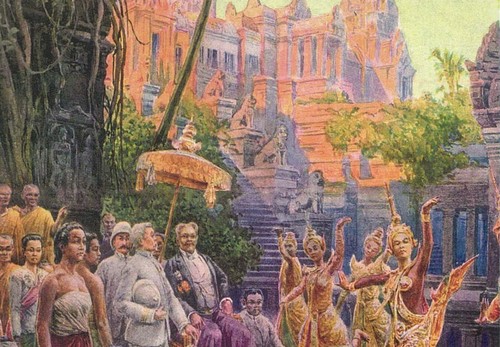
Literature was not considered an art form until the 1930s and 1940s, when short stories, plays and novels began to appear, most of them published on the pages of magazines. Around this time the Khmer term for literature, aksar sastr, began to come into use. Modern Cambodian novels of this period included Rim Kin’s Sophat (‘Name of the Hero’), which in 1938 was turned into a popular modern theatre play, and Kim Hak’s Tek Tonle Sap (‘The Waters of Tonle Sap’), published in serial form in Khmer and French in Kambuja Surya Magazine, the Journal of the Buddhist Institute. This organisation, initially called the Royal Library of Cambodia, was created by the École Française d’extrême-orient (EFEO), and French academics were much involved in the choice of published material and in Khmer language scholarship in general.
Other leading novelists of this pre-war period included Nhok Them, Mith Sokhon and Nou Hach, whose works still remain popular today.
THE MODERN AND CONTEMPORARY CAMBODIA LITERATURE
Between 1938 and 1972 over 1,000 novels were printed, ranging from detective and adventure tales to mysteries, historical novels and love stories. After independence from French colonization, Cambodian literature was added to the national educational curriculum. With the establishment of the Khmer Writers’ Association in 1956, writers were recognised as making a cultural contribution in their own right and the institutionalisation of Khmer literature appeared complete.
During the Khmer Rouge era (1975-1979), however, there was little literary activity. Nonetheless, creative writing put in song lyrics became a norm, which were set to music using established musical forms from popular theatre and folk dances.
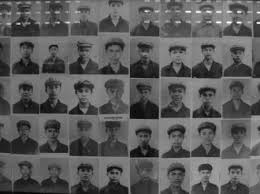
Prison that fed the Killing Fields
http://www.foreignpolicyjournal.com
The mass killings, starvation and hard labors carried a heart to memoirs and biographical works expressing the sufferings of the survivors and the horror of the era. Writers who were allowed to write were the intellectuals living overseas, most famously perhaps through Dith Pran’s memorable work The Killing Fields, which was subsequently turned into a feature film.
During the PRK regime of the 1980s, the government placed a high value on literacy, and nationwide campaigns were held to ‘liberate’ the masses from illiteracy, while prizes were offered for novels, poems, songs and drama on officially approved themes of war and socialist reconstruction.
In this climate, novels as a means of escapism and healing national wounds were in high demand. Some of Cambodia’s leading novelists, including Mao Samnang and Pal Vannirath, established their reputations without having their work published, but rather through distributing handwritten manuscripts and photocopies through market stalls. Pal Vannirath, a prize-winning revolutionary writer, wrote more than a dozen sentimental novels but was not able to openly publish them in book form.
Khmer literature by Cambodian writers living in France and the USA also began to appear during the 1980s and 1990s. Many of these are survivors’ accounts which have begun to provide insight into the experiences of those who lived through the Khmer Rouge regime, and provide some depth of social realism.
Source: vietlongtravel.com
 LitLover